WELCOME..... TO .....HIGH SCHOOL BIOLOGY BLOG !!!

Wednesday, October 5, 2011

Translocation in Plants

(A) Mass-Flow/Pressure Flow Hypothesis:

 1.   The mass-flow/pressure flow hypothesis:
-   postulates that dissolved sugar moves in phloem
-   by mean of pressure gradient
-   which exists between the source and sink.
2.   The photosynthetic cells in:
      -   leaves = common source of sugars
      -   roots = sinks.
3.   At the leaves
-   sucrose is actively transported
-   from mesophyll cells
-   to companion cell
-   into sieve tube
-   against its concentration gradient
-   process = phloem loading.
-   high conc of sucrose à lowers cell water potentialw)↓.
-   water - drawn into sieve tube
-   from nearby xylem vessel
-   creating a high hydrostatic pressure (HP)
-   forces the bulk/mass flow of the phloem sap
-   towards the sink.

Phloem loading and unloading of sucrose


4.   At the root:
-   sucrose is actively transported
-   from the sieve tube
-   into the companion cell
-   into a root cell.
-   process = phloem unloading.
5.   Loading (at the source) and unloading of sugar (at the sink)
      - require energy derived from ATP.

(B) In Electro-Osmosis Mechanism:
  • potential diff develops across sieve plate
  • by companion cell (actively transport K+ into sieve tube).
  • K+ accumulate at one end of sieve plate 
  • creates a potential diff between sieve plate.
  • caused K+ speed across sieve plate
  • water + dissolved sucrose follow (attracted by +ve charge).
  • water in phloem moves by osmosis 
  • as accumulation of K+ lower Ψw in sieve tube (compared to next cell).


K+ accumulate at one end of sieve plate creates a potential diff between sieve plate


(C) In Cytoplasmic Streaming Mechanism:
  • water + dissolved compounds (in phloem sap) 
  • move + circulate together
  • in one direction (in sieve tube)
  • it’s slow + depends on metabolic energy/due to their kinetic energy.
  • circulation slow down at sieve plate
  • and forced out from cytoplasmicc streaming (thru pores)
  • to cytoplasmic streaming of next sieve tube.

Circulation slow down at sieve plate


(D) In Peristaltic Wave Mechanism:
  • sieve tube is filled with fine cytoplasmic filaments
  • continuous from sieve tube to the next
  • thru pores of sieve plate.
  • contain phloem sap tube constrict + relax alternately
  • pushing sap from one sieve tube to the next.
  • constriction + relaxation/peristaltic movement form a pattern of wave = peristaltic wave
  • can be at diff speed + in opposite direction (in sieve tube)
  • depends on metabolic energy/ATP.


Phloem sap tube constrict + relax alternately


Monday, September 12, 2011

Transport of Water: Mechanism

1.      Two theories to explain water + minerals transport in plants
-   root pressure theory
-   cohesion-tension theory.
2.      Root-pressure theory:
-   accumulation of mineral ions in the xylem
-   enhances water molecules to move into root hairs (by osmosis).
-   water pressure ↑ builds up in the root
-   pressure pushes up water +  dissolved minerals
-   through the xlem
-   toward the top of the plant.
-   but not strong enough to push up water to the top of tall trees.
Root pressure


3.      In small plants:
-   root pressure can build high enough
-   to force water and minerals completely out of the tips of the leaves
-   the process = guttation
4.      Cohesion-tension theory suggests that:
-   water inside the xylem is pulled upward
-   by the -ve pressure (or tension)
-   that extends all the way from leaves to roots.
5.      In the leaf xylem:
-   -ve pressure (tension) builds
-   as water evaporates during transpiration.
-   evaporated water is continually replaced
-   thus cohesive bond pull the string of water molecules up
-   to create a transpiration pull.
-   transpiration pull is relayed
-   molecule by molecule
-   down the entire column of water in the xylem.

Transpirational pull in the leaf


6.      In the stem, water molecules:
-   exist as a long unbroken chain in the xylem.
-   are pulled upwards by tensions produced (during transpiration).
-   are held by cohesion + adhesion forces

Cohesion and adhesion forces in the xylem


7.      Transpiration pull:
-   can extend down to the roots
-   only through an unbroken chain of water molecules.
8.      At the cellular level:
-   the gradients of water potential
-   drive the osmostic movement of water
-   from cell to cell
-   within the roots up to the leaves.

Water potential in leaf, stem and root

Transport of Water: Concept

1.      Dissolved substances (inside a plant cell) = contribute to solute potential (ψs).
2.      More solute molecules present --> the lower is the water potential (ψ).
3.      When water pontential is lower than> external solution:
-   water molecules move into the cell .
-   pressure inside the cell increases
-   sell contents press against the cell wall
-   create a pressure potentials).
4.      Water potential (of a plant cell) = solute potential + pressure potential.
5.      Water potential = free energy of water.
6.      By convention, water potential of pure water = 0 megapascal (MPa).
7.      Water will move:
-   from a region of higher (less -ve) water potential
-   to a region of lower (more -ve) water potential.
8.      In plasmolysed cell:
-   pressure potential = zero
-   water potential = solute potential.
9.      As more water molecules enter a cell
-   pressure potential ↑ increases
-   so is its water potential
-   cell becomes turgid.
-   less and less water molecules enter the cell.


10.  Most minerals
-   are actively transported into the root.
-   there is a gradient of successfully
-   lower water potentials  from root hair to the xylem vessels
-   result in water uptake by osmosis is enhanced.
11.  Water moves by osmosis in the roots follows three pathways:
-   apoplast
-   symplast
-   vacuole.
12.  Apoplastic pathway:
-   water travels along the cell wall
-   and extracelular spaces.

Apoplast pathway


13.  Symplastic pathway:
-   water moves across the cytoplasm of one cell to the next
-   across the plasma membrane
-   through the plasmodesmata.

Symplast pathway


14.  Vacuole pathway:
-   water moves from vacuole to vacuole of one cell to the next
-   across the plasma membrane
-   through the plasmodesmata.
  
Vacuole pathway

Tuesday, July 19, 2011

Cardiac cycle


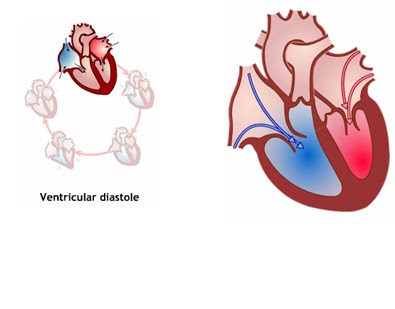
Cardiac Cycle

1.       Heart contracts + relaxes in a rhythmic cycle.

2.     Cardiac cycle consists of alternating periods of :
·        Systole - contraction phase.
·        Diastole - relaxation phase.

3.     Cardiac cycle = one complete sequence of systole + diastole

4.     Resting adult - cardiac cycle repeated 72 times per minute = resting heart rate.

5.     Pulse = causes by elastic recoil of arteries.

6.     Ventricular pressure + aortic pressure + ventricular volume:
  • changes (in response to the events that occur)
  • at different phases of cardiac cycle.
7.     During diastole:
  • pressureof heart chambers decreases
  • volumeincreases (as blood is pumped in).
8.     During systole:
  • pressureof heart chambers increases
  • volumedecreases (as blood is pumped out).
9.     When aortic pressure > ventricular pressure
à semilunar valves shut + vice versa.

10.  When ventricular pressure > atrial pressure
à AV valves shut + vice versa.

11.   Valves = ensure blood only flows in right direction.

Tuesday, July 12, 2011

Transport In Animals

1. Human heart : 
  • consists of 4 chambers : right atrium, right ventricle, left atrium and left ventricle
  • pump blood to all parts of the body.
  • made up of cardiac muscle. 


Front/venrtral  view of heart
 
2. Superior vena cava
    --> carries deoxygenated blood
    --> from the head + arms
    --> into right atrium.
3. Inferior vena cava
    --> carries deoxygenated blood
    --> from the lower body + legs
    --> into right atrium
4. Right atrium
    --> receives deoxygenated blood
    --> from vena cava
    --> to right ventricle. 
5. Tricuspid (antrioventricular) valves
    --> prevent blood (from right ventricle) flowing backwards
    --> to the right atrium.
6. Right ventricle
    --> pumps blood
    --> to lungs
    --> via pulmonary arteries.
7. Semilunar valves
    --> prevent blood (from pulmonary arteries)
    --> from flowing backwards
    --> into right ventricle.


Cross-section of heart


8.   Pulmonary artery branches
      --> carries deoxygenated blood
      --> from right ventricle 
      --> to lungs.
9.   Pulmonary vein
      --> carrying oxygenated blood
      --> from lungs
      --> to left atrium.
10. Left atrium
      --> receives oxygenated blood
      --> from lungs 
      --> to left ventricle.
11. Bicuspid (atrioventicular) valves
      -- > prevent blood (from left ventricle) flow backwards to left atrium
12. Left ventricle
      --> pumps oxygenated blood
      --> to body tissue (via aorta).
13. Semilunar/aortic valves
      --> prevent blood (from aorta) flowing backwards (into left ventricle).
14. Aorta
      --> carries oxygenated blood
      --> from left ventricle
      --> to the rest of the body.
15. Septum separates the right and left side of the heart.


Simplified version of heart